Data sovereignty
Secretly Sovereign
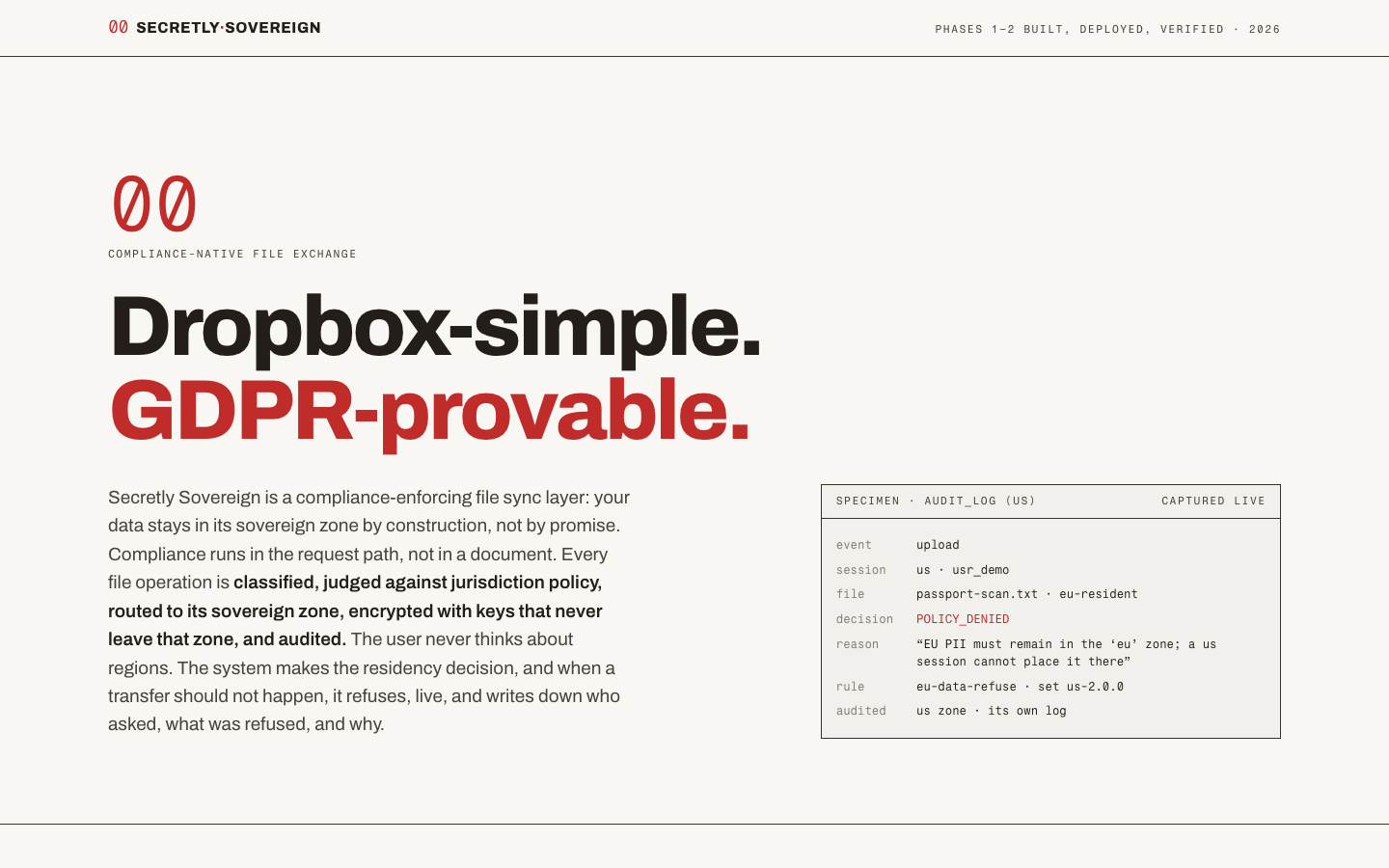
File sync and share that enforces data sovereignty by design. Residency, processing locality, and key ownership aren't commitments in a compliance binder; they're what the system physically does.
Who it's for
People who have to prove it, not just claim it.
Operators and compliance teams whose job is demonstrating, to a regulator, an auditor, or a hostile counterparty, that data stayed where the law says it must. Most tools answer that question with a policy PDF. Secretly Sovereign answers it with an audit trail of decisions the system was incapable of making any other way.
The everyday experience is ordinary file work: browse, upload, share, delete. Residency decisions are visible when you look and silent when you don't.
Mechanism
Every file operation, every time
- Classify.
The file is classified on intake, before anything else can happen to it.
- Policy-decide.
Jurisdiction policy is evaluated against the classification. Denials are first-class results with the exact reason attached.
- Route.
The file is routed to the correct sovereign zone. There is no code path that skips this step.
- Encrypt with a zone-scoped key.
Keys belong to the zone. Data encrypted for one jurisdiction is unreadable infrastructure anywhere else.
- Store, then audit.
Every decision is recorded. When an auditor asks what happened, you show them; you don't assure them.
The guarantee
Sovereignty is a property of the pipeline, not a promise about it. A misconfigured operator can't move data to the wrong jurisdiction, because routing and key scope make the wrong jurisdiction unable to read it.